
The Azuchi–Momoyama period was the final phase of the "Sengoku" period in Japan, a time of social upheaval. It spans from 1573 to 1600. During this time Oda Nobunaga and Toyotomi Hideyoshi tried to regain order of the country after the fall of the Ashikaga shogunate.[30]
Paintings
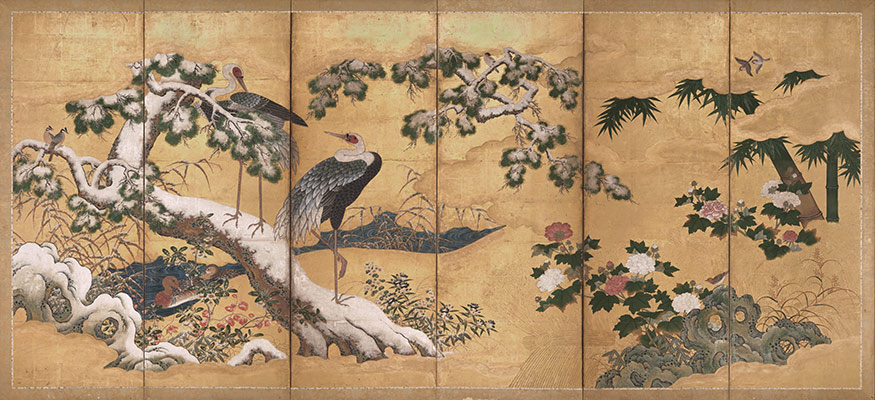 |
Birds and Flowers of the Four Season [30a]
|
The prominent school for art during this time was the Kano school. It taught two distinctive styles of painting: bright, opaque colors on top of a gold or silver background, and a freehand, bold ink style with monotone colors. While there were other schools that taught similar techniques, the Kano school was most popular and highly regarded.[30]
References:
[30a]The Metropolitan Museum of Art (2000) The Kano school of painting | essay | Heilbrunn Timeline of art history | the metropolitan museum of art. Available at: http://www.metmuseum.org/toah/hd/kano/hd_kano.htm (Accessed: 23 February 2017).
[30] The Editors of Encyclopædia Britannica (2013b) ‘Japanese art - Azuchi-Momoyama period’, in Encyclopædia Britannica. Available at: https://www.britannica.com/art/Japanese-art/Azuchi-Momoyama-period (Accessed: 23 February 2017).